My personal journey into the wonderful world of daylilies began in earnest in 2018 after seeing some random photos on social media. I was so fascinated with the new introductions from overseas that I started to study the internet to learn more. I was not new to importing seeds having previously imported cottage garden seeds from South Africa, hippeastrum seeds from Europe and the USA, and clivia also from USA. I love the unusual, I admit. So I checked the permitted seed list https://www.agriculture.gov.au/biosecurity-trade/policy/legislation/permitted-seeds
and found that Hemerocallis (daylily) is listed as permitted for importation, so I made contact with a couple of hybridizers in the USA and I was off and running. Oh but it is so addictive!! I couldn't stop. Of course I made mistakes in the beginning. I don't like double handling anything if I can avoid it - so rather than get my seeds started in potting mix and pots I put them straight in the ground. Nothing wrong with this idea - except I was working a very stressful position and my free time was so limited that weeds overtook my seed bed and sadly I lost a lot of really good stock. So the following season I imported a whole lot more. I saw my daylily passion as a hobby for my retirement. I still had a couple of working years to go so I planned that my seedlings would be mature enough by the time I retired to bring me in a little hobby income. I had previously grown iris and sold through local markets and social media so I knew I was on to a good thing.
I had maybe 3 or 4 dozen seedlings from my first year of import survive, but I made sure to grow the second lot in pots (I actually start them in plastic cups) for later transplant. Much more successful!!

Well . . . . we all know what happened in 2020. Covid!! I was still working at this time, but I had 4 months of leave owing so I took that time and started preparing proper beds for my seedlings and planted them out. I didn't return to work - by the time my leave was over I only had a few months until pension age so I stayed away in my garden.
Falling in Love with Daylilies
Obviously daylilies have been available in Australia for many years, but importation of actual plants ceased somewhere around 2012-2013 I believe. I had previously grown daylilies myself alongside my irises and when my husband and I moved to our current location, I concentrated on bringing my irises as at that time they were my main passion. This turned out also not to be a very wise decision as unknown to us at the time, our current home is situated in one of the windiest spots - as attested to by the influx of wind turbines recently. Irises and daylilies, although pretty much on a par as to height differ considerably in the fact that iris stems are not very flexible, whereas daylilies will move and sway with the wind. Consequently my irises were getting snapped off and bloom was very poor. So I changed direction.
I did import more through 2020, and then I started to get some magnificent blooms of my own so I started to work my own hybridizations. Regulations started to change toward the end of that year and I had a parcel of seeds destroyed on entry into this country. I don't believe I ever found out the reason why, just received a notification that they had been destroyed. Possibly they had started to grow en-transit, or had become mushy. My loss.
Consider the Lilies
It has since become even more difficult to import seeds. They must be accompanied by a Phytosanitary Certificate to ensure seeds imported are safe to bring into the country, free from pests and diseases. Although I agree this is an important step to protect our country's flora, it puts an added burden on the seller, as they have to arrange for an inspection of the seeds on their property so that they can be cleared by the inspector as suitable for exportation. This means that the seller has to clean their seeds, to ensure there is no debris or excess plant matter that could be mistaken for tiny insects. Naturally there is a fee for this service, which the seller generally passes onto the purchaser. A lot of sellers are not prepared to go through this process because there are such an abundance of growers in their own country, who will pay very good money for seed that there really is no need for them to look for overseas purchasers and put themselves to this additional bother. Thankfully though, a few growers will. However, even procuring a Phytosanitary Certificate does not ensure seeds will be delivered to the purchaser. Randomly seeds will be withheld at entry for a nursery inspection when they enter this country. This of course creates an additional fee. If the seeds are considered not to be healthy (i.e. mushy or mouldy) they will be destroyed. So it really is quite a risky business. I occasionally do still import, because I have some great contacts, and it is the only way to keep up with current genetics. There are a few like-minded hybridizers now in this country that I am aware of and we have been known to swap plants, seed and pollen to keep the gene pool at its best. But we do have the additional hurdle that we cannot all send to every state of this country without excessive costs being incurred.
From my own perspective, I am extremely happy with the genetics I have in my 'patch' and I have been happily dabbing pollen for the last 4 years or so. It takes generally 2 years for a seed to reach blooming stage (I have actually had the very occasional one that will do this within 12 months, but that is rare) and I am now starting to enjoy the blooms from my very own crosses. When reading a daylily cross the pod parent is mentioned first and the pollen parent second. Until a seedling is registered (if indeed it ever is) it is basically known by the cross. For example, the very first seedling that I registered is "Consider the Lilies". This is a diploid plant crossed by placing pollen from a daylily called Garden Fairy onto the stigma of one called Rhapsody in Green. So Consider the Lilies is registered as (Rhapsody in Green x Garden Fairy).

Consider the Lilies
What Does a Diploid Plant Mean?
What is a diploid plant you may ask. A diploid is a daylily with 2 sets of chromosomes compared to a tetraploid, which has four. These are the 2 most common forms of daylily, however they can also come with more (polyploid) but that is far less common. So, when it comes to hybridizing it is important to cross plants with similar ploidy or the pollination is unlikely to be successful. Again, our overseas friends are very advanced with technology in this field and some are converting diploids to tetraploids using colchicine to convert the ploidy. This process is way over my head and I am not aware of anybody in Australia undertaking it, but generally tetraploids often are far more robust than diploids, with much stronger, thicker substance. Diploids on the other hand can throw very vibrant colours, so this course of conversion has over the years given opportunity to introduce better colours and patterns into tetraploids. Regardless, I love them all and carry a vast collection of both diploids and tetraploids. Diploids to me are generally more dainty but there are of course exceptions to the rule.
After dabbing pollen on a bloom, I mark the flower with a tag and record the two parents on a spreadsheet. It generally takes 46 to 56 days for the pod to mature and once the pod starts to split the seed is ready to harvest. This is rule of thumb only, the weather can impact on this and in an extremely hot season the pod may dry and open prematurely but I still collect and plant the seeds and I would generally expect to see bloom two years later. If the seed is soft and mushy of course it won't be viable. Pollen can be used either fresh, or it can be stored and frozen for later use. Just ensure to mark the pollen before freezing with an identification tag so you know what you are using when the time comes. I mark mine with name, date of collection and ploidy. Some people allow the seeds to dry for a day or two then put them in the fridge for a while (cold stratification), but I prefer to plant mine after a day or two of picking. My location has relatively mild winters, just an occasional frost, no snow or major freezing, so I personally don't feel the need to give my seeds a cold snap before planting. I have worked with both methods and quicker planting has generally given me better germination results. I guess it is a case of trial and error, but it is a lot of fun!

This is an example of a set of seeds collected from a single pod. It was a very large pod on a diploid plant – I don’t generally get so many seeds from an individual pod. Sometimes they yield only one seed.
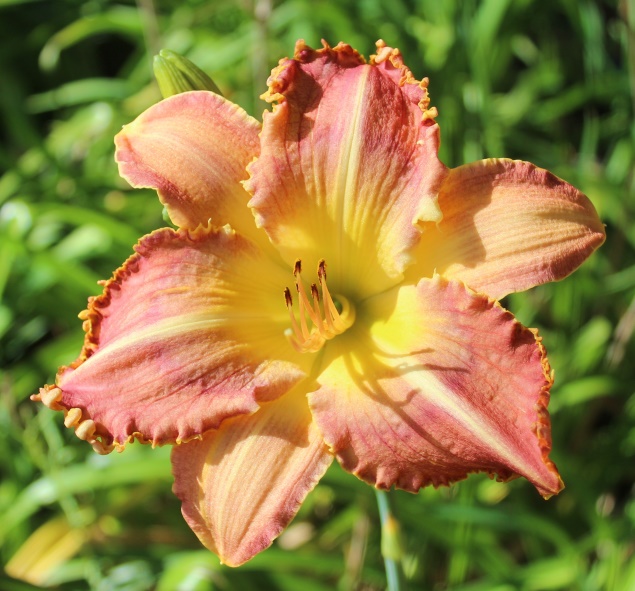
To give an example of the immense fun cross pollinating daylilies can bring I will share a picture of my latest seedling. This picture was taken of its maiden bloom and I am so very happy with it – it will only improve with age. The cross is (Knoll Cottage Almost Bit My Hinny x Abalone Bite) grown from a seed I purchased from USA crossed with pollen from (Deadliest Catch x Devil’s Haircut) another USA seed purchased from a different hybridizer. The results is . . . . .

KNOLL COTTAGE ALMOST BIT MY HINNY “a” x DEADLIEST CATCH X DEVIL’S HAIRCUT “b”
Pod Parent: Pollen Parent:


Sometimes every seed in the pod is similar, but sometimes you can get a vast variety from the siblings and sometimes you get something that has a throwback to previous generations and it gives you something completely unexpected. It brings me so much pleasure and I urge other gardeners to give it a try.
Why Daylilies Are So Easy to Grow
Daylilies come in a wide range of colours, patterns, shapes and sizes and are very forgiving, can withstand drought, frost, snow . . . it seems anything you can throw at them, and they increase mainly by forming fans, or developing proliferations along the flowering stem (scape). Proliferations sometimes form at an intersection on the scape known as a bract. A grouping of leaves will grow and sometimes roots will form while the proliferation is still attached to the scape. The proliferation can be cut off and potted and will grow true to the parent plant. If no roots have formed in situ it can be placed in a jar of water for a few days to get the roots started. Not every variety will throw proliferations though . . . it is a bonus if they do!!
These beautiful flowers may have plain edges, gentle ruffles to thick pie-crust edges and even toothy edges. Some are single, some double, some with sculpted pleated petals. Shapes vary from round form to cascading and spider form just to name a few. They are dormant during winter months and fall into either deciduous, semi-evergreen or evergreen categories, sometimes leaving a full clump of leaves, to being completely bare but surviving underground during winter. The range of colour is endless, patterns too are endless. Absolutely fascinating blooms. Bloom size also is variable – with miniatures 3” and under to large blooms of 7” or more. Of course height too varies considerably – in my own garden they range from 14” to 45”, which makes them so versatile for landscaping – tall for the back of the bed and short for the front.


A Few Facts About Daylilies
Interesting facts/notes:
Daylilies are not true lilies. Although commonly called lilies, daylilies (Hemerocallis) are not true lilies (Lilium). They belong to a different plant family and have very different growth habits.
Each individual flower only lasts one day, hence the name “daylily”. But each plant produces many buds over weeks. Some varieties are rebloomers, which means they will send up new scapes when initial bloom is finished.
Toxicity warning: Toxic to cats (can cause kidney failure if ingested.)
While daylilies are wonderful garden plants, they can be toxic to cats if ingested and should be considered carefully for pet-friendly gardens. I myself have 2 cats that often join me in the patch, neither of whom have suffered any ill effects from playing amongst my daylilies, but it is important to be aware. They are however, not toxic to dogs.
Did I mention that I LOVE daylilies??
Check out my daylilies in my PlantArk store and bring more colourful joy into your life!
 Author: Jenny – Bunspatch